Marvel Rivals Vertical Threats: Assign a Response Without Abandoning the Objective
A threat above the normal sightline can divide attention. Identify who can respond with the current kit, preserve support on the ground and avoid making every teammate chase the same target.
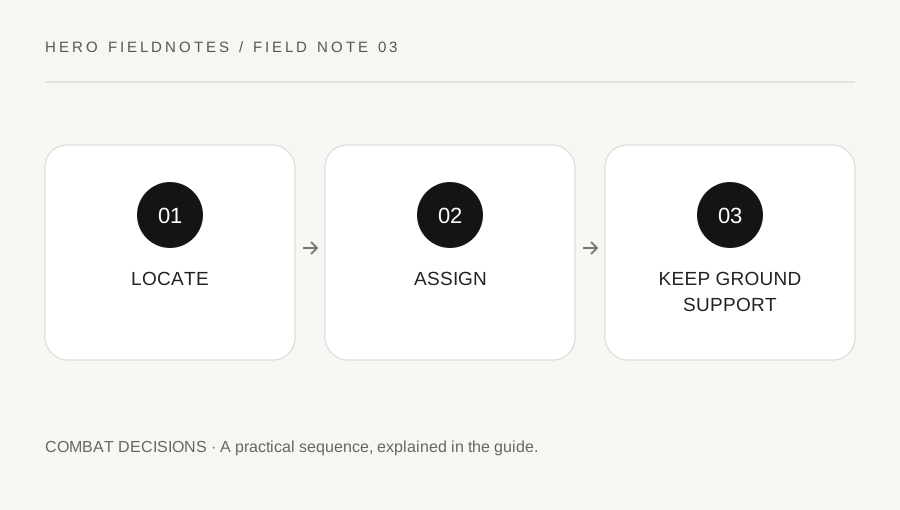
Original explanatory diagram. Examples illustrate a method or decision; they are not claims of personal testing.
Describe the threat and its position
Call the hero or visible threat only as confidently as the view supports, along with approximate direction and elevation. A brief silhouette is not a complete account of its abilities or current resources. Keep the location useful rather than shouting a name without a place.
Read current hero descriptions for movement and attacks. The roster and balance evolve, so this guide does not publish a permanent counter chart or a claim that one hero always wins the interaction. The team's actual kit determines which responses are practical.
Also identify what the threat is doing. Pressure on a support position, control of a route and damage from a distant angle create different priorities. The fact that something is high does not automatically make it the most urgent target in every objective state.
Choose who can respond effectively
Inspect which teammate has a useful view and an attack suited to the actual position. A player with no practical reach may contribute more by preserving ground control or supporting the teammate who can act.
Avoid turning the response into every player looking upward simultaneously. That can remove attention from the objective and nearby opponents. A clear assignment lets the team preserve complementary jobs rather than duplicating one action.
For a worked example, a high threat pressures the back line while a ground fight continues. One teammate takes the relevant angle, another helps the threatened support move to cover, and the rest maintain the objective connection. This is an illustrative coordination pattern, not a prescribed composition or a guarantee of a particular hero matchup.
Use cover and support before a long chase
Look for a position that limits the high threat's view while preserving useful team connection. A move beneath or behind suitable geometry may change the interaction without requiring an immediate elimination. Inspect the actual map rather than assuming one cover shape works everywhere.
If a teammate pursues, check what happens to their return and support. Vertical movement can separate a hero quickly. A damaged target is not permission to abandon every ground responsibility indefinitely.
Update when the opponent changes elevation or leaves the angle. The response should follow the actual threat, not continue because the first call was made. Keep current information concise so a teammate does not hold an empty sky angle while a more urgent problem appears elsewhere.
Review the division of attention
After the fight, ask who responded, what remained covered and whether the objective connection survived. A failed elimination does not automatically mean the response was useless if it reduced pressure long enough for the team to act. Conversely, a successful chase can still lose the objective through abandonment.
Choose one practice task such as checking an elevated angle from a support position or learning a current hero's reach in the practice environment. Keep it small and verify the actual attack behavior.
Finish with location, responder and preserved job. This makes vertical defense a team decision rather than a panic reaction. The useful habit is matching a real threat with a practical response while keeping the rest of the fight organized, not demanding that every teammate solve the same airborne or elevated target at once.
A practical checklist
Choices are saved in this browser. Reset them here or clear this site’s browser storage.
Questions that come up
Should everyone aim upward at once?
Not automatically. A coordinated response preserves the objective and other angles while suitable teammates address the threat.
Does this page name a permanent best counter?
No. Use the current roster, kit and actual position rather than a fixed matchup promise.
Can moving to cover be a useful response?
Yes when the geometry and team connection support it. An immediate elimination is not the only way to reduce pressure.
References & scope
Background references checked on 18 October 2026. Worked examples and diagrams are original teaching material.