Marvel Rivals Third-Person Angles: Separate the Camera View From the Attack Path
A third-person camera can show a space that your hero cannot yet attack from cleanly. Practice around one piece of cover and compare what the camera sees with the actual supported attack result.
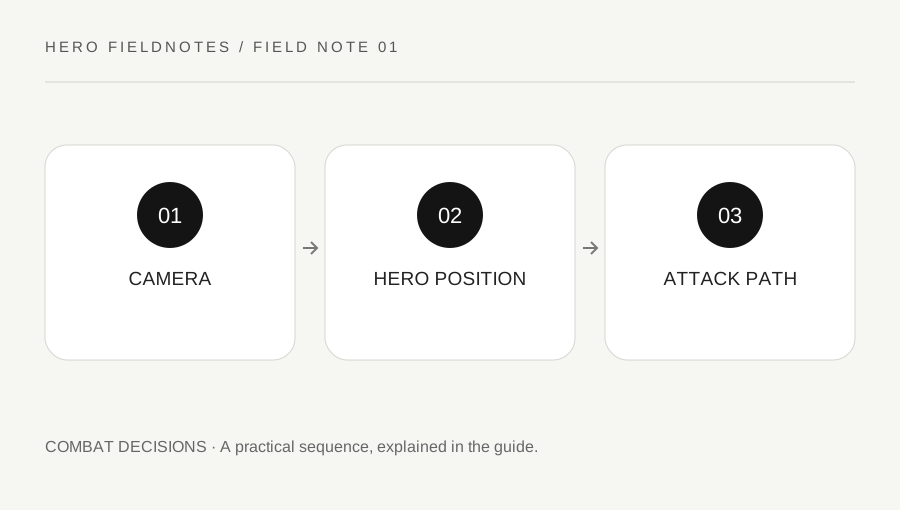
Original explanatory diagram. Examples illustrate a method or decision; they are not claims of personal testing.
Start with one hero and one attack
Choose a familiar hero and read the current attack description. Marvel Rivals includes different attack types and hero shapes, so do not assume every projectile, beam or melee action behaves alike. Keep one attack and a stable practice setting for the first comparison.
The developers describe third-person perspective as central to embodying the hero. That camera perspective also makes it useful to distinguish the visual view from the position of the character and attack. An opponent visible beside cover is not automatically a clean target from the current body position.
This guide offers an observation exercise rather than a universal collision formula. Use the actual hero, current game and supported practice tools. Avoid installing an overlay or modification that claims to reveal hidden positions or automate the adjustment.
Compare the cover edge slowly
Stand beside a simple obstacle and identify what the camera shows. Move a small amount, use the chosen attack in a permitted practice context and inspect the actual result. Keep the target and distance stable so that the cover relationship is the main variable.
Record whether the attack was obstructed, reached the intended target or required another position. Do not infer an exact invisible boundary from one attempt. A different hero or attack can need another check.
For a worked example, a player can see a practice target around an edge but their attack meets the obstacle. They adjust the hero's position and repeat deliberately, then return to cover. The lesson is the relationship between camera, body and attack, not simply aiming harder at a target that was visible all along.
Include the exposure created by the adjustment
Moving far enough to attack can also expose the hero to more of the opposing view. Check the protection lost when stepping beyond the edge. A clear shot is only one part of a useful position.
Keep support lines in mind. A teammate may need a view of your new location to help, and a small lateral movement can change that connection. The site's role guides cover broader positioning; this page isolates a camera-and-cover interaction that can affect several roles.
Do not remain outside cover simply to prove the attack now works. Practice the complete action: inspect, adjust, act and return or move to the next useful position. This keeps the mechanical discovery connected to a real combat decision rather than a stationary demonstration.
Transfer the observation carefully
In a normal encounter, notice one moment when a visible target is not a useful attack opportunity. Ask whether cover, attack type or hero position explains it before blaming sensitivity or a technical problem.
If the result seems inconsistent, keep the hero, ability and location in the note and review current updates. A reproducible issue can go through official support, while an unverified impression should remain uncertain. Do not claim that every missed attack is a camera bug.
Finish with a hero-specific note about the cover interaction you verified. That is more useful than a universal third-person trick. The goal is learning where the hero can act while preserving protection, with the camera view supplying information rather than being mistaken for a guarantee that every visible target is reachable.
A practical checklist
Choices are saved in this browser. Reset them here or clear this site’s browser storage.
Questions that come up
Does seeing a target guarantee a clear attack path?
No. Hero position, cover and attack type can matter. Check the actual supported behavior.
Does one test apply to every hero?
No. Different attacks and character geometry can require separate comparisons.
Should every miss be called a camera bug?
No. Review cover, position and attack behavior before drawing a technical conclusion.
References & scope
Background references checked on 18 October 2026. Worked examples and diagrams are original teaching material.