Marvel Rivals Peel Decisions: Protect the Threatened Teammate Without Losing the Fight
Peeling means redirecting useful attention to a teammate under pressure. Identify the threat, the help your kit can provide and the position to return to before turning assistance into an endless chase.
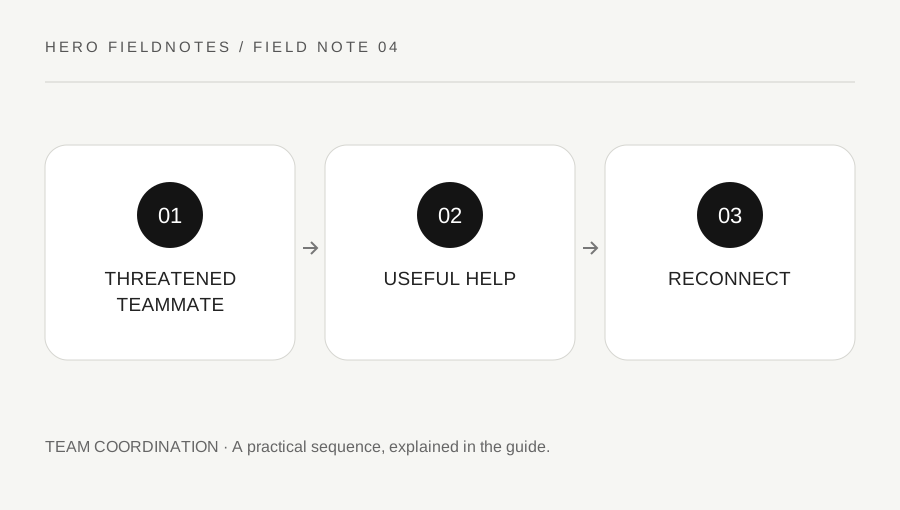
Original explanatory diagram. Examples illustrate a method or decision; they are not claims of personal testing.
Confirm who needs help and why
A teammate's low health, a nearby enemy and a lost support line are different observations. Read the actual situation rather than assuming every call for help requires the same response. Ask where the threat is and what action would change the pressure.
The game's roles provide a starting framework, but a role label does not establish that one player must solve every threat alone. Current hero abilities and positions determine who can help effectively. Read the live kit rather than using an outdated counter rule.
This guide complements the Strategist-positioning article by focusing on the teammate's decision to assist. Protection can involve pressure, a supported defensive effect or helping the teammate reach a better position. It is not defined solely by eliminating the attacker.
Choose an action the current kit supports
Identify the function you can supply from your actual position. A teammate across a blocked line may need a route change rather than another shouted request. Do not promise help that the range, cooldown or map geometry does not permit.
Keep the action specific and concise. “Helping this side, move toward the cover” can organize the next moment more clearly than several players making unrelated attacks. Observe the teammate's route so your response does not accidentally leave them moving away from the available support.
For a worked example, an attacker pressures a support hero behind the main group. A nearby teammate turns, applies a useful supported response and helps restore the support connection. They do not continue pursuing the attacker through several unknown turns after the original teammate has reached safety.
Keep the objective and other angles covered
Redirecting attention has a cost. If every player turns away at once, another lane or the objective can become unprotected. Name who helps and what the remaining players preserve when communication allows.
Use the actual urgency. A severe immediate threat may require a rapid response, while a distant nuisance may be handled by position and cover. Avoid treating every contact as a full-team emergency.
If a cooldown is spent, communicate the practical change when it affects the next engagement. A successful peel can leave an important defensive function unavailable temporarily. Read its current description and actual state rather than assuming it resets because the attacker left.
End the assistance when its purpose is met
Once the threatened teammate is safe enough to contribute, reconnect with the team's next action. An attacker retreating can tempt the helper into a long chase that creates the same separation the peel was meant to fix.
Review whether the response restored useful participation. A scoreboard elimination is not the only evidence; a teammate surviving and rejoining the objective can be the intended result. Keep the evaluation tied to the original problem.
Finish with one coordination note: threat identified, help supplied and position restored. If the help failed, locate the missing connection, such as blocked view or late information. That gives a practical next task without reducing the encounter to blame or assuming that a role label guarantees protection regardless of range and readiness.
Practice a brief response call such as "turning back to our support" before changing direction. That lets another teammate continue pressure deliberately instead of assuming everyone is following the retreating opponent.
A practical checklist
Choices are saved in this browser. Reset them here or clear this site’s browser storage.
Questions that come up
Does peeling require eliminating the attacker?
Not always. Restoring a teammate’s useful position or reducing pressure can achieve the purpose.
Should the whole team turn for every contact?
Not automatically. Match the response to urgency while preserving the objective and other angles.
Should I keep chasing after the teammate is safe?
Reassess. An endless chase can create a new separation and lose the original team connection.
References & scope
Background references checked on 18 October 2026. Worked examples and diagrams are original teaching material.